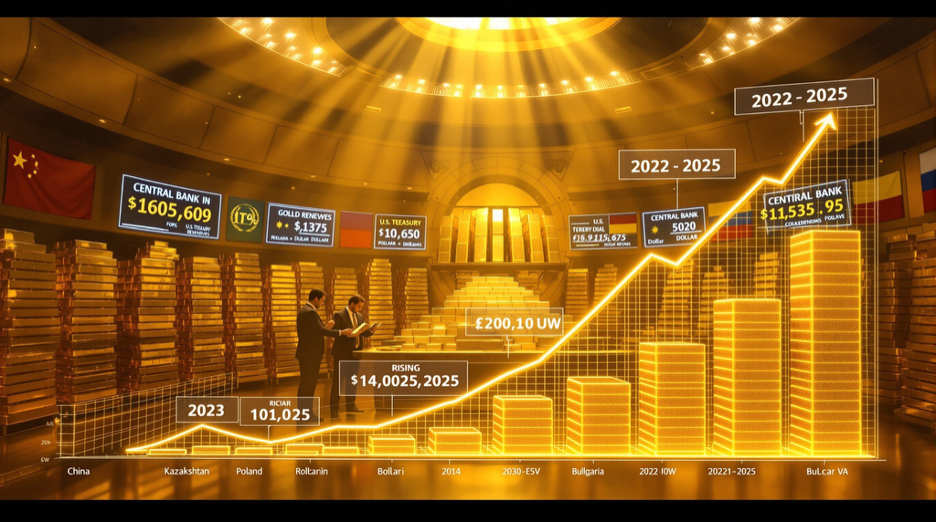
Central banks are among the most powerful participants in the global gold market. When they begin increasing gold reserves, the impact often extends far beyond institutional portfolios. Gold prices, investor sentiment, liquidity conditions, and overall market behavior can all shift rapidly. For retail investors, central bank activity may appear distant or unrelated to everyday gold investing. In reality, these institutions play a major role in shaping long-term gold demand and influencing global market confidence. Understanding how central bank buying affects gold prices helps investors move beyond short-term headlines and better understand the deeper forces driving the market.
Why Central Banks Buy Gold
Central banks hold gold as part of their national reserves. Unlike retail investors, they do not buy gold for short-term speculation. Their purchases are usually tied to broader economic and strategic objectives. Common reasons central banks increase gold reserves include diversifying away from foreign currencies, reducing dependency on the US dollar, protecting reserves during economic uncertainty, strengthening long-term financial stability, and hedging against inflation and currency volatility. Gold is viewed as a reserve asset that maintains value independently from most financial systems. This makes it attractive during periods of geopolitical or economic instability.
How Central Bank Buying Impacts Gold Prices
When central banks increase gold purchases, overall market demand rises. Since gold supply cannot expand rapidly in the short term, stronger institutional demand often places upward pressure on prices. Large-scale buying can influence global spot prices, investor sentiment, retail demand, and market momentum. The market often interprets aggressive central bank buying as a signal that institutions expect increased economic uncertainty or long-term currency risks. This perception alone can strengthen gold demand globally.
Institutional Confidence Influences Retail Investors
Retail investors closely watch institutional behavior, especially during uncertain market conditions. When central banks consistently increase reserves, many investors interpret it as a sign that gold is becoming strategically important again. This can trigger increased retail buying, fear of missing out, momentum-driven investing, and higher overall demand. In highly active gold markets like the UAE, these global demand shifts can influence local pricing and investor psychology very quickly.
Gold Becomes More Attractive During Currency Uncertainty
Central bank buying often increases during periods of currency instability or weakening confidence in fiat systems. When inflation rises or major currencies become volatile, gold tends to gain attention as a more stable reserve asset. Central bank accumulation reinforces this narrative because it signals that large financial institutions are prioritizing asset protection over currency exposure. This creates stronger long-term confidence in gold markets.
Liquidity and Market Tightening
Heavy institutional accumulation can also affect market liquidity. When large volumes of gold are absorbed by central banks and institutional buyers, available supply may tighten, market competition can increase, premiums may rise, and spreads may widen temporarily. Retail investors sometimes notice stronger pricing movement during these periods even without major changes in local demand. Professional investors monitor liquidity closely because liquidity conditions often reveal hidden market pressure before headlines do.
Why Central Bank Buying Matters More Than Headlines
Gold markets are heavily influenced by perception and confidence. Central bank activity carries significant psychological weight because these institutions operate with deep economic research, long-term reserve strategies, and macro-level financial planning. When central banks increase gold holdings consistently, markets often interpret it as a strategic warning signal about broader economic uncertainty. This is one reason why institutional buying can have a stronger influence on long-term gold behavior than short-term retail activity alone.
The Relationship Between Inflation and Central Bank Buying
Inflation plays a major role in central bank gold strategies. When inflation pressures increase globally, purchasing power weakens, and fiat currencies may lose value over time. Gold becomes more attractive because it is perceived as a long-term store of value. Central bank buying during inflationary periods often strengthens broader investor confidence in gold markets. This can create long-term bullish momentum beyond short-term speculation.
Why Professional Investors Watch Institutional Flows
Professional investors focus heavily on institutional behavior because institutional flows often shape long-term market direction. Instead of reacting emotionally to daily price movement, experienced investors study central bank reserve trends, institutional accumulation patterns, liquidity shifts, and macro-economic positioning. This creates a more structured understanding of how gold markets evolve over time.
The Shift Toward Smarter Gold Investing
Modern investors increasingly want deeper understanding around institutional demand, market structure, liquidity conditions, long-term positioning, and pricing efficiency. This is changing how investors approach gold markets globally and in the UAE. Platforms like Belora reflect this shift by helping investors focus on the deeper mechanics behind gold investing rather than simply following short-term market movement.
Final Insight
When central banks increase gold buying, the impact extends beyond simple price movement. Institutional demand can influence liquidity, investor psychology, market confidence, and long-term global pricing behavior. The smartest investors understand that gold markets are shaped not only by charts and headlines, but also by the strategic decisions of the world’s largest financial institutions. Because in modern gold investing, understanding who is buying often matters as much as understanding the price itself.